Introduction: Navigating UK Expansion
Expanding your business into the United Kingdom presents a wealth of opportunities, but a critical early decision for foreign parent companies is choosing the appropriate legal and accounting structure. The choice between establishing a UK branch (often referred to as a UK Establishment) or incorporating a limited company subsidiary carries significant implications for your operational costs, legal liabilities, tax obligations, and overall market perception. Making an informed decision is paramount for your long-term success in the UK market.
The UK Branch (UK Establishment): A Direct Extension
What is a UK Branch?
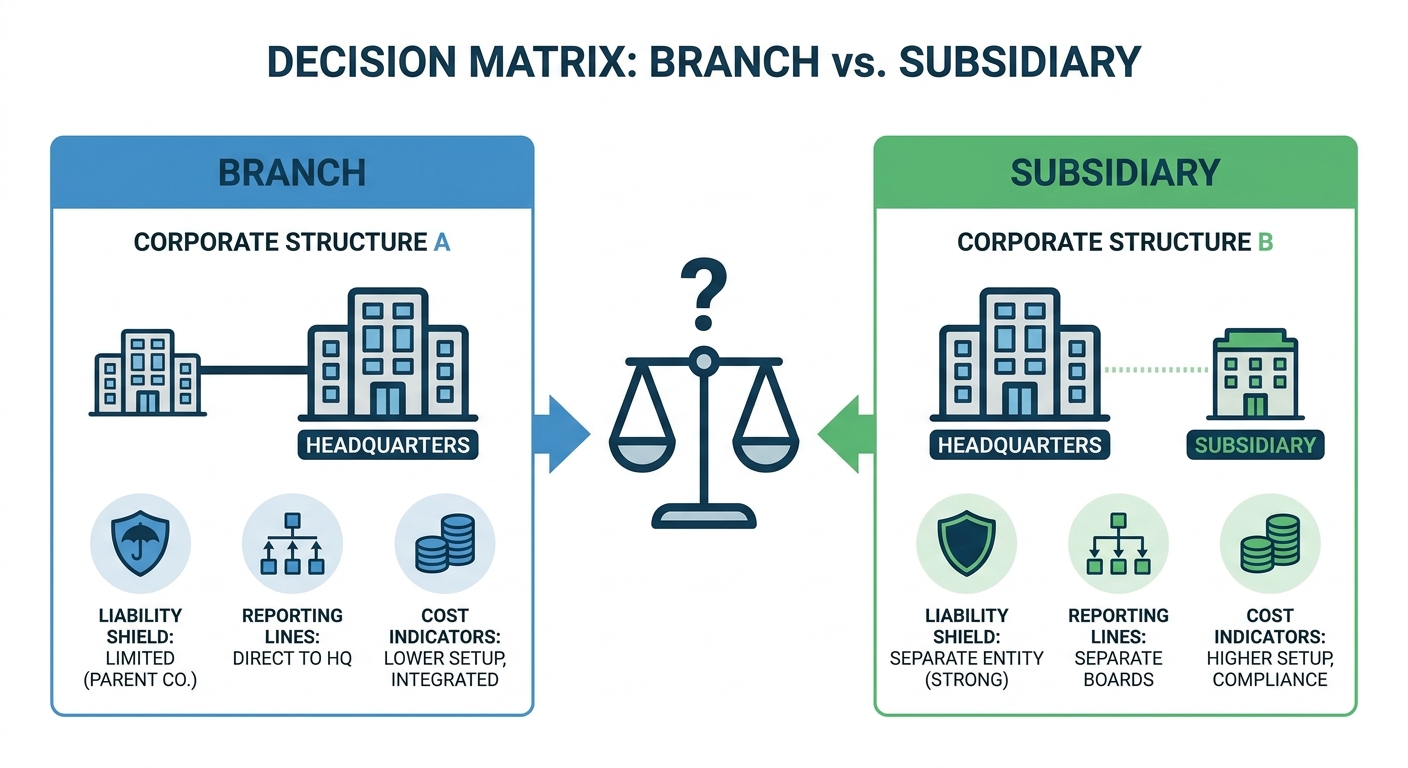
A UK branch is essentially an extension of your existing foreign parent company. It is not a separate legal entity but rather a fixed place of business in the UK through which the foreign company conducts its activities. Branches must be registered with Companies House as an 'oversea company' within one month of commencing operations in the UK.
Advantages of a UK Branch
- Simpler Setup: Generally, setting up a branch can be quicker and involve less initial paperwork compared to forming a new company, especially if the parent company's structure is straightforward.
- Direct Control: The parent company retains direct and full control over the branch's operations, assets, and liabilities.
- Streamlined Inter-company Transactions: Transfers of funds and assets between the parent and the branch can be less complicated from a legal standpoint, though tax implications still apply.
Disadvantages and Key Considerations
- Unlimited Liability: This is the most significant drawback. The foreign parent company is fully liable for all the debts, obligations, and legal claims incurred by its UK branch. This means the parent company's global assets are at risk.
- Public Scrutiny of Parent Finances: UK branches are required to file the parent company's financial statements with Companies House. If these accounts are not in English, certified translations are mandatory, which can be an ongoing administrative burden and cost. This exposes the parent company's global financial health to public record in the UK.
- Perception: A branch might be perceived by some local clients, suppliers, or banks as less committed or permanent in the UK market compared to a locally incorporated entity.
- Taxation: While subject to UK Corporation Tax on profits attributable to its UK activities, determining the taxable profit for a branch can sometimes be complex, especially concerning the allocation of overheads and inter-company charges.
The UK Subsidiary: A Separate Legal Entity
What is a UK Subsidiary?
A UK subsidiary is a new, distinct limited company incorporated in the UK, owned and controlled by the foreign parent company. It has its own legal personality, separate from its parent. This means it can enter into contracts, own assets, and incur liabilities in its own name.
Advantages of a UK Subsidiary
- Limited Liability Protection: The primary benefit is that the parent company's liability is limited to its investment in the subsidiary. The subsidiary's debts and legal obligations do not typically extend to the parent's global assets, offering crucial risk mitigation.
- Enhanced Local Credibility: Operating as a UK limited company often enhances credibility with local customers, suppliers, banks, and regulatory bodies. It projects a strong, long-term commitment to the UK market.
- Easier Access to Finance: UK subsidiaries may find it easier to secure local financing, loans, or grants from UK financial institutions.
- Tax Efficiency: As a distinct entity, a subsidiary can often take advantage of UK tax incentives and rules, and its taxable profits are clearly defined by its own financial performance.
Disadvantages and Key Considerations
- Greater Setup Complexity: Incorporating a new company involves more formal steps, including drafting Articles of Association, appointing directors and shareholders, and adhering to stricter company law requirements from the outset.
- Separate Compliance Burden: A subsidiary must comply with all UK company law and accounting regulations, including preparing and filing its own annual accounts, corporation tax returns, and confirmation statements. This requires a dedicated local accounting function.
- Higher Initial and Ongoing Costs: The setup and ongoing compliance for a separate legal entity are generally more expensive due to increased administrative and professional fees.
- Profit Repatriation: Transferring profits from the subsidiary to the parent typically involves formal dividend distributions, which may have tax implications in both the UK and the parent company's jurisdiction.
Key Comparison: Branch vs. Subsidiary
Legal Liability
The starkest difference lies here. A branch offers no liability protection to the parent, while a subsidiary provides crucial limited liability, safeguarding the parent's core business.
Taxation
Both structures are subject to UK Corporation Tax on their UK-generated profits. However, the calculation of taxable profit, especially for inter-company transactions, can differ. Subsidiaries often have clearer tax treatment as independent entities. Both will likely require VAT registration if turnover thresholds are met.
Administrative Burden & Compliance
Branches require filing the parent company's accounts with Companies House (often requiring certified translations). Subsidiaries prepare and file their own dedicated UK accounts and tax returns, generally leading to a more robust and localised compliance framework.
Public Perception & Market Credibility
A subsidiary typically enjoys greater local credibility and trust, which can be advantageous for business development, talent acquisition, and securing partnerships within the UK.
Requirement for Certified Translated Financial Statements
This is a critical practical point. For a branch, if your parent company's financial statements are not originally in English, you will face recurring costs and administrative effort for certified translations to meet Companies House filing requirements. A subsidiary, as a separate UK entity, only needs to prepare and file its own accounts in English, removing this specific translation burden.
Making the Right Choice for Your UK Expansion
The decision between a branch and a subsidiary is highly dependent on your specific business objectives and risk appetite:
- Risk Tolerance: If mitigating legal and financial risk to the parent company is paramount, a subsidiary is usually the preferred option.
- Long-Term Strategy: For a temporary market test or a project with a defined end, a branch might offer sufficient simplicity. For a long-term, significant commitment to the UK market, a subsidiary often proves more strategic.
- Brand Perception: If strong local credibility and a perception of permanence are crucial for your target market, a subsidiary is beneficial.
- Administrative Capacity: Assess your resources for managing UK compliance, including the specific requirements for certified translations of foreign financial statements if opting for a branch.
Conclusion: Seek Expert Guidance
Choosing the correct legal and accounting structure for your UK expansion is a pivotal strategic decision. There is no one-size-fits-all answer, and the optimal choice depends on a careful evaluation of your business model, financial position, risk profile, and long-term aspirations. To ensure compliance, maximise tax efficiency, and minimise potential pitfalls, it is highly recommended to consult with experienced UK legal and accounting professionals. Their tailored advice can help you navigate the complexities and establish a solid foundation for your international growth.